VENICE-O-METER 8
Psychological short story / novella partly set in Venice
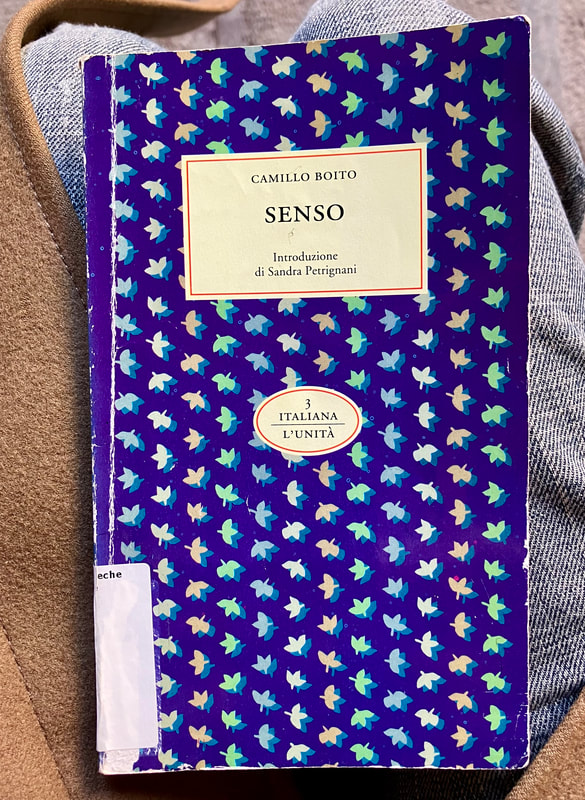
Like Death in Venice, Senso was famously adapted for the cinema by Luchino Visconti. Both are brief stories are set in Venice and chronicle an ill-fated love obsession.
(Speaking of obsessive love — Visconti shot much of Senso in Venice, including the opening scene, set in the Fenice opera house. When the Fenice was rebuilt after burning to ashes in 1996, the movie was used a reference in order to recreate the auditorium’s exact shade of blue. It speaks to Visconti and his DP’s meticulousness use of light and color.)
While key parts of Senso, notably the denouement, are not set in Venice, I gave it a Venice-O-Meter score of 8 because in my opinion the city plays an active part in the story — it is not just a picturesque background, as in so many works of fiction, though fashionable places such as the Caffè Quadri on Piazza S. Marco — you’ll find details on the Reading Venice Map. The narrator, Livia, feels born anew in Venice (“A Venezia rinascevo.”) and seems to interact intensely, physically, with the city’s unique features, in particular the water.
Livia details how the wind and the sea make her feel when riding boats to Sant’Elena or to the Lido. So powerful is her commitment to the laguna that she spontaneously throws a valuable ring — given to her by her husband — into the waves, thus symbolically marrying the sea, as the leaders and the people of Venice have been doing for over 1,000 years on the occasion of the Festa della Sensa.
Livia also attends the floating Rima resort where, mermaid-like, she delights in bathing in a gondola fitted for that purpose (a “sirena”), and feels one with the waves — this primal, Edenic pleasure contrasting sharply with the scenes of slaughter and destruction that follow, as Livia is finds herself in the middle of the 1866 Italian-Austrian war.
“Oh la bella acqua smeraldina, ma limpida, alla quale vedevo ondeggiare vagamente le mie forme sino ai piedi sottili! e qualche pesce piccoletto e argentino mi guizzava intorno. Nuotavo quant’era lunga la Sirena; battevo l’acqua con le mani aperte, finchè la spuma candida coprisse il verde diafano; mi sdraiavo supina, lasciando che si bagnassero i miei lunghi capelli e tentando di rimanere per un istante a galla, immobile; spruzzavo la cameriera, che fuggiva lontana; ridevo come una bimba. Molte larghe aperture, appena sotto il livello dell’acqua, lasciavano entrare e passare l’acqua liberamente, e le pareti, mal commesse, permettevano, attraverso le fessure, di vedere, applicandovi l’occhio, qualche cosa al di fuori — il campanile rosso di San Giorgio, una linea di laguna, dove fuggivano leste le barche, una fetta sottile del Bagno militare, che galleggiava a piccola distanza della mia Sirena.”
 Reading Venice